Monday, February 21, 2011

ACTH

ACTH seems to be the medicine we will be asking for at our Epileptologist appointment next week. My time has been spent into the early morning hours researching medical journals, IS studies, blogs, and message boards, I feel like I have learned so much about neurology and Infantile Spasms in these few "short" (hah!) days.

Typically they admit children into the hospital to begin treatment on ACTH, and train parents on how to give the injections (yes, shots...). After seeing the cost per vile of this medicine, which we found our insurance doesn't cover, I finally had to get on a message board and ask how families pay for them. Someone responded immediately and told us about
NORD, the National Organization of Rare Diseases, who picks up the cost of medicine for diseases like IS. I spoke with them today to confirm, and they said that they do pick up most/ all of the cost and deal with insurance issues. You will never even believe how much each vile is...

$29,000. Per. Vile.

Insane, huh??

And people still think nothing is wrong with our healthcare, especially when our insurance conveniently doesn't cover it. But that is a whole other soapbox...

There appears to be no guarantee, but ACTH has the highest success rate out of all medications. But with the chance for improvement/success, comes many side effects:

  • Cushingoid - Most children will gain weight and retain extra fluid during the time they receive ACTH. This weight may be seen with facial puffiness. The appetite increases and the children crave more food.
  • Irritability with increased crying
  • Decreased sleeping
  • High blood pressure, heart failure
  • Calcifications of kidney and pancreas
  • Increased risk of infections
  • Increased blood glucose
  • Loss of milestones, including smiling, motor skills

Children receiving ACTH should have blood pressure, weight and serum electrolytes monitored frequently during the time they are receiving the ACTH.

From what I have read the most common is the weight gain and Cushingoid features, that are so visually startling. I have "borrowed" these photos from a couple of blogs, I hope the bloggers don't mind:


This is an adorable 20 month old girl, before starting treatment:

Here she is only 5.5 weeks in, after gaining 10 lbs., putting her at 32.5 lbs.:


Little guy, before treatment:


45 days into ATCH:


Luckily, they seem to lose the weight almost as quickly as it is gained. Here he is 2 weeks after:

And then, 5 months later:


Are we scared?

Terrified. But all these side effects don't compare to the alternative. So, we are praying this is the medicine offered and the medicine that changes Deacon's life.

Saturday, February 19, 2011

Deacon Verse

We found this the other night while reading our bible:

Deacons, likewise, should be worthy of respect, not hypocritical, not drinking a lot of wine, not greedy for money, holding the mystery of the faith with a clear conscience. And they must also be tested first; if they prove blameless, then they can serve as deacons...Deacons must be husbands of one wife, managing their children and their own households competently. For those who have served well as deacons acquire a good standing for themselves, and great boldness in the faith that is in Christ Jesus. (1 Timothy 3:8-13)

We made no mistake in naming Deacon, meaning "Pastor or faithful servant."

Thursday, February 17, 2011

Infantile Spasms

Name sounds non-threatening, right??

We only wish...

Today was Deacon's doctor appointment, and that was the diagnosis given. Infantile Spasms fall under the epilepsy umbrella, although unlike normal seizures, Infantile Spasms are connected with pretty severe developmental delays in most cases.

I found this article online that sums up what we are facing:

"Infantile spasms is one of the 'catastrophic childhood epilepsies' because of the difficulty in controlling seizures and the association with mental retardation. However, early recognition, a careful diagnostic evaluation, and proper treatment may allow some children to attain seizure control and to achieve a normal, or at least much improved, level of development. Thus, there is the opportunity to have an important impact in the lives of these unfortunate children and their families.

Infantile spasms is arguably the most interesting, but also the most enigmatic, of all the epilepsy syndromes. Infantile spasms was one of the first epilepsy syndromes described. In a letter to the editor of The Lancet in 1841, Dr. WJ West's description is as clear as any modern portrayal. He recounted that the patient had “bobbings” that “cause a complete heaving of the head forward towards his knees, and then immediately relaxing into the upright position … these bowings and relaxings would be repeated alternately at intervals of a few seconds, and repeated from 10 to 20 or more times at each attack, which attack would not continue more than 2 or 3 minutes; he sometimes has 2, 3 or more attacks in the day .” West also reported on the consequences of infantile spasms: marked developmental delay and mental retardation. Sadly, the patient who West was describing was his own son, and the letter was a request for help in treatment.

Spasms are easily missed, especially if they occur singly or in small or infrequent clusters. Other potential symptoms that parents might notice are a loss of muscle tone, loss of head control or reaching ability, loss of eye contact, inattention to sounds, lack of responsiveness, poor smiling, or decrease in alertness.


An etiologic diagnosis is very important because it can lead to initiation of a specific therapy that may markedly improve the long-term developmental outcome. In fact, some children with infantile spasms may ultimately lead normal lives, but only if they are diagnosed and treated correctly. Unlike treatment of other seizure types, there is only one goal for treatment of infantile spasms: the complete control of spasms. If spasms cannot be controlled, the child is unlikely to do well developmentally, and a 50% or 90% reduction does not provide for this possibility.

Prognosis:

Infantile spasms is associated with a significant risk of mortality and morbidity. Riikonen has followed 214 infantile spasms patients for 20–35 years and has accumulated the best long-term follow-up studies of these patients (4, 24). In her series, nearly one third of the patients died during the follow-up period, many in the first 3 years of life. Eight of the 24 patients who died by age 3 died of complications of therapy with ACTH. (Those who treat large numbers of infantile spasm patients do not see such a high mortality rate, which largely is due to improved medical capabilities.) Of the 147 surviving patients, 25 (17%) had a favorable developmental outcome with an IQ of 85 or greater. Eleven others were in the dull–normal range, with an IQ of 68–84. Thus, of the 214 patients diagnosed with infantile spasms, 31% died, 45% were retarded, but 24% had a reasonably favorable outcome. The outcome is dependent on two major factors. First and foremost is the underlying etiology. Some etiologies will lead to death or mental retardation, whether or not the patient developed infantile spasms. However, children with cryptogenic (unexplained) infantile spasms or infantile spasms that is due to remediable etiologies, such as focal cortical dysplasia, may have a normal or near normal developmental outcome if seizures are controlled. Thus, the goal of therapy is to achieve control as soon as possible, especially for children who may have the potential for normal intellectual development."

So what now??

I think we are still trying to digest everything from today. The neurologist told us we are doing all the right things with getting his glasses, MRI, EEG, hearing test, and ECI. But we still are feeling helpless at this point with another game of wait-and-see...

Here are our plans for the upcoming weeks:
  • He changed the medication from the Keppra (we were unhappy with, anyways) to Topamax, which we will start tonight.

  • We scheduled another EEG for the same day as his vision specialist (and our dr. was glad that we chose her because she is a pediatric neuro opthamologist) on the Feb. 24th.

  • We also have an appointment on the 28th with an epilepsy specialist to hopefully find the cause, if known. (Right now from what I have read, the only explainable causes for Infantile Spasms are loss of oxygen, head trauma, or a couple of diseases he doesn't appear to have.) The neurologist said that we would also discuss with them a possible medicine, ACTH, that is given through shots.
  • Lots of online research!
Thank you everyone for your prayers this far. We are still holding out hope that Baby Deacon will be the exception and can lead a happy, healthy life, and prayers are definitely welcome.

Wednesday, February 16, 2011

Deacon's 1st Birthday

Deacon's celebrated his 1st birthday this past weekend at our house with a Dr. Seuss theme. Our close family and friends came and made the party great for Deacon!

As always, our gal did a fantastic job on the cake!


We made place cards to match the theme for all of our food:


Wocket Pocket's (Stuffed Pita)

Yertle Turtles (Turtle candy)


Green Eggs and Ham (Deviled Eggs and Spinach Tortilla Roll-Ups with Ham)


Poodles with Noodles (Pasta Salad)


1 fish, 2 fish, red fish, TUNA fish (Tuna Fish Sandwiches and goldfish)


Pink Yink Drink


We ordered some decorations online too, but I forgot to get pictures of it all:


And our goodie bags had seuss pencils, buttons, tattoos, balls and airhead candy (for "The Places You'll Go"):


Deacon received lots of toys and clothes:


We gave him an Alex Jr. Trampoline, since he loves bouncing so much!


...and he wasn't the only one who enjoyed it!


Deacon has a definite sweet tooth, so he was ready and all about the cake when it was time!


Before:


After:


We had to put a hold on the party just to give Deacon a bath and wash the cake out of his hair, nose and ears! But, he was raring and ready to enjoy the rest of the party as soon as he had his wardrobe change!


Happy Birthday Sweet Baby D!

Wednesday, February 9, 2011

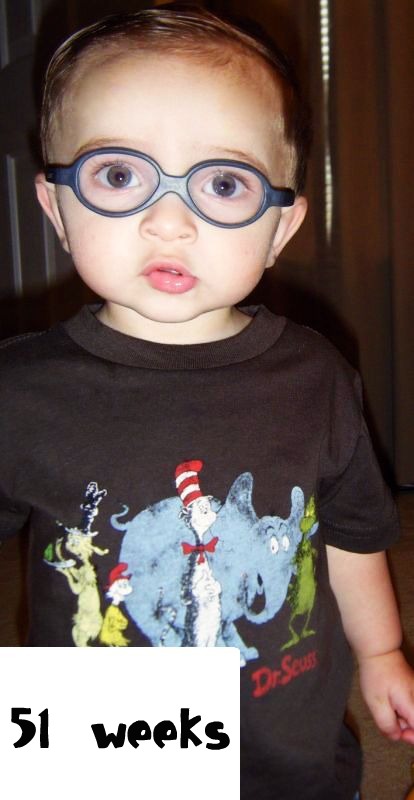
Deacon's B-day Invites: 51 Weeks

Now that invitations should be delivered for Deacon's party, I can finally post a copy! I'm sure you have noticed by now, I a huge fan of Picnik... I used their site to create his invitation to match his Dr. Seuss themed party for this weekend, along with a seuss-y poem.
His picture turned out so adorable, I went ahead and made it his weekly picture too!

I cannot believe we only have one weekly picture left to take... I started the first picture with little expectations of sticking with it for the whole year, but am SO happy we were able to not only capture weekly snapshots of his cute little face, but also track little milestones that may have been forgotten.

Deacon, this week you danced for the first time, which, in my opinion, is PERFECT timing for your first birthday party!

Friday, February 4, 2011

Carson's Valentine Exchange

A couple of weeks ago we stopped by my favorite teacher supply store and ran across this fun stuff:


It is snow in a jar! The product is made up of a powdery substance that you mix with water and it turns into a texture that feels exactly like snow without the coldness. One little tub of this stuff make over 11 gallons of "snow" that lasts 4-6 weeks! We had so much fun with it, but had no idea what we would do with 11 gallons until I remembered Valentine's Day is coming up and would make a perfect replacement for the 20 lbs. of candy classes of kids usually receive. And even better now that Houston didn't receive the snow we were hoping for today!

Walmart had Valentine goody bags and these small plastic hearts that are the perfect size to hold the snowy powder:


And, as always, Picnik helped us personalize the cards/instructions:


Final product:

Tuesday, February 1, 2011

ECI Interview

Today Deacon had his appointment with Early Childhood Intervention. An Occupational Therapist and Early Intervention Specialist came to our house to observe and interact with Deacon, and asked lots of milestone questions for their evaluation to see if he qualified for services.

Both girls were really nice and very thorough in answering questions. They used huge timelines with milestones listed on them, and highlighted the areas where he is successful. His gross motor skills are even above where they should be, but like we suspected, the fine motor skills (manipulating items with his hands), language, and socialization showed some deficits. He does qualify for services and starting next week will receive an hour of Occupational Therapy and an hour of Developmental Therapy per week at his daycare at no cost to us. They will send a report home following each visit with suggestions of activities to do at home and will also train his daycare teachers with the same activities while he is at school.

They left with a list of suggestions for us to start incorporating immediately, and I am excited to start helping him! I feel a little better knowing that we have a plan of action and support while we wait for answers from doctors.